
Hospital waste management
Get a FAST & FREE quote for hospital waste collection
Just enter your postcode…
 Our use of cookies
 This website uses cookies to ensure you get the best experience on our website, to read more about the cookies we use, please read our cookies policy here.
Necessary cookies enable core functionality such as security, network management, and accessibility. You may disable these by changing your browser settings, but this may affect how the website functions.
Get a FAST & FREE quote for hospital waste collection
Just enter your postcode…
Start saving now
Choosing the right provider for your hospital’s waste collection is essential for maintaining hygiene standards, ensuring compliance with healthcare regulations, and keeping costs under control. Here’s why hospitals across the UK trust us to manage their waste:

We offer hospital waste collection services across the UK, supporting everything from small private clinics to large NHS hospitals. No matter your location, you’ll have access to professional, reliable, and compliant waste services.

We work exclusively with experienced and fully licensed clinical waste providers who understand the specific requirements of healthcare environments. Your hospital waste is handled safely and responsibly, from infectious waste to sharps and pharmaceutical disposal.

Our team will prepare a bespoke quote tailored to your hospital’s specific waste streams and collection needs. We offer competitive pricing without compromising on compliance, safety, or service standards.
Hospitals generate a wide range of waste streams, many of which require specialist handling due to infection risk, legal controls, and patient safety requirements.
From wards and operating theatres to laboratories, pharmacies, kitchens, and offices, each area produces different types of waste. Effective segregation at source is essential to prevent contamination and remain compliant with healthcare waste regulations.
Below are the main waste categories managed within hospital and healthcare environments.

Clinical and infectious waste includes materials contaminated with blood, bodily fluids, or pathogenic microorganisms. This typically arises from patient treatment, diagnostics, and infection control procedures.
Common examples include dressings, swabs, PPE, testing materials, and disposable medical equipment.
This waste must be segregated at the point of use, stored securely, and disposed of using a dedicated clinical waste collection service.

Sharps waste consists of any item capable of puncturing skin and causing injury or infection. This includes needles, syringes, lancets, scalpels, and certain broken medical devices.
Due to the high risk of needlestick injuries, sharps must be disposed of immediately after use in rigid, tamper-proof containers. These containers are sealed and collected for specialist treatment and destruction.
Proper sharps management is a critical part of staff safety and infection prevention protocols.

Cytotoxic and cytostatic waste is generated primarily through chemotherapy services and specialist pharmacy departments. It includes medicines, syringes, tubing, PPE, and materials contaminated with anti-cancer drugs and hormone therapies.
These substances are hazardous to human health and the environment, even in very small quantities. Cytotoxic and cytostatic waste is typically placed in purple-lidded or purple-bagged containers and disposed of through high-temperature incineration at licensed facilities.
Pharmaceutical waste includes expired, unused, damaged, or partially used medicines generated by wards, pharmacies, and treatment areas.
This category may include tablets, liquids, creams, vaccines, and controlled drugs.
Medicines must never be disposed of through general waste or drainage systems. Instead, they are segregated and processed through approved pharmaceutical waste treatment routes to prevent environmental contamination and misuse.
Offensive waste is non-infectious waste that may be unpleasant but does not pose a clinical risk.
Examples include incontinence pads, nappies, wipes, and hygiene products that are not contaminated with infectious material.
Although not classified as hazardous, this waste requires careful handling, sealed storage and a dedicated Sanitary waste service.

Anatomical waste includes human or animal body parts, tissues, organs, and blood products generated during surgical procedures, post-mortem examinations, and laboratory work.
This waste is subject to strict legal and ethical controls. It must be stored in designated refrigerated containers and disposed of through licensed high-temperature incineration facilities.
Management procedures for anatomical waste are closely monitored and documented.

Chemical and laboratory waste arises from diagnostic testing, pathology services, cleaning processes, and research activities.
It may include solvents, reagents, disinfectants, laboratory samples, and contaminated containers.
Many of these substances are classified as hazardous and require specialist packaging, labelling, and disposal to prevent environmental damage and staff exposure.
Not all hospital waste is hazardous. Large volumes of non-clinical waste are produced in offices, reception areas, kitchens, staff facilities, and public spaces.
To manage this efficiently, most hospitals operate multiple waste streams alongside their main clinical waste systems, including:
Waste segregation is a core part of hospital waste management. It ensures that different waste streams are handled safely, treated correctly, and disposed of in line with legal and clinical standards.
In healthcare environments, segregation begins at the point where waste is generated, such as bedside areas, treatment rooms, laboratories, pharmacies, and kitchens. Once waste is placed in the correct container, it follows a controlled pathway through storage, collection, and treatment.
Poor segregation increases infection risk, raises disposal costs, and can lead to regulatory non-compliance.
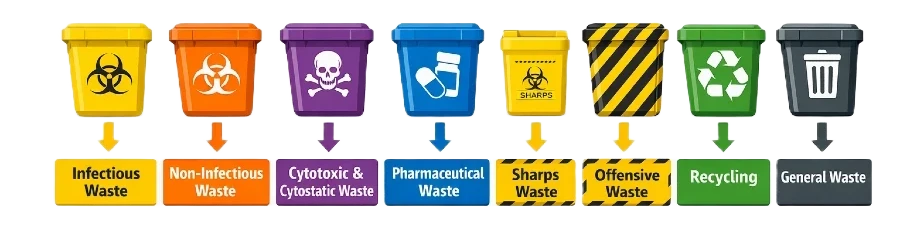
Most hospitals use a colour-coded system to identify different waste types quickly and consistently across departments.
While exact specifications may vary slightly by provider, common colour categories include:
These colour codes allow staff, cleaners, and waste handlers to recognise waste types quickly and reduce the risk of misclassification.
Segregation at source means placing waste into the correct container at the point where it is produced, rather than sorting it later.
This is both a legal and operational requirement in healthcare settings.
From a compliance perspective, healthcare waste regulations require hazardous, clinical, and pharmaceutical waste to be kept separate from non-hazardous materials.
Operationally, early segregation:
Once waste streams are mixed, they must be treated as high-risk, even if most of the material is non-hazardous.
Despite formal systems, segregation errors remain one of the most common waste management issues in healthcare environments.
Typical problems include:
These mistakes often occur during busy periods, staff shortages, or when training is inconsistent.
Over time, repeated errors can indicate wider issues with workflow design, bin placement, or internal waste policies.
Different waste streams are treated using different methods, each with its own cost structure.
Clinical, pharmaceutical, anatomical, and chemical waste requires specialist treatment, which is significantly more expensive than standard recycling or general waste processing.
When non-hazardous materials enter hazardous waste streams, hospitals effectively pay high-risk treatment rates for low-risk waste.
Poor segregation can therefore:
Well-managed segregation systems help hospitals control expenditure, improve resource efficiency, and maintain predictable waste budgets.
Get a FAST & FREE quote for hospital waste collection
Just enter your business postcode…
Start saving now
Once waste has been correctly segregated, hospitals must manage how it is moved, stored, and secured within the building before external collection takes place.
This internal handling stage is critical for maintaining hygiene standards, preventing cross-contamination, and ensuring compliance with healthcare waste regulations.
Poor storage practices increase infection risk, attract pests, and expose staff, patients, and visitors to avoidable hazards.
Most hospital waste is first stored temporarily in designated holding areas close to where it is produced, such as utility rooms, sluice rooms, or service corridors.
These areas are designed to:
Waste should not be left in patient areas, public corridors, or clinical workspaces for extended periods.
Hospitals operate strict zoning systems to separate clean activities from waste handling processes.
Clean zones include treatment rooms, medication preparation areas, and sterile storage spaces. Dirty zones include waste rooms, sluice areas, and waste transfer corridors.
Internal waste movements are planned to avoid crossing clean routes wherever possible. This reduces the risk of contamination and supports infection prevention policies.
Many hospitals use dedicated lifts, corridors, and access points for waste transport.
Hazardous waste streams, including pharmaceutical, chemical, anatomical, and cytotoxic waste, require enhanced security during storage.
These materials are usually kept in:
Access is limited to authorised staff, and storage areas are monitored to prevent tampering, misuse, or accidental exposure.
Different waste types are subject to maximum on-site storage periods, depending on their infection risk, odour potential, and regulatory classification.
While hospitals aim to arrange collections well before these limits are reached, understanding the recommended thresholds helps estates teams and waste managers plan storage capacity, collection schedules, and contingency arrangements.
The table below outlines typical guidance-based storage time limits for common hospital waste streams.
| Waste type | Maximum on-site storage (inside) | Notes |
|---|---|---|
| Infectious clinical waste | Up to 14 days | Typical maximum before off-site transfer is expected. |
| Offensive (non-infectious) waste | Up to 14 days | Same guidance as infectious waste for internal storage. |
| Refrigerated anatomical waste | Up to 14 days | Must be kept refrigerated until collection. |
| Unrefrigerated anatomical waste | 24 hours (or up to 72 hours over a weekend) | Short window due to odour and infection risk. |
| Cytotoxic & cytostatic waste | Up to 6 months | Includes chemotherapy drugs and certain hazardous medicines. |
| Other pharmaceutical & chemical waste | Up to 6 months | Applicable to many hazardous drug and lab chemical streams. |
Source: Gov UK – Healthcare waste: appropriate measures for permitted facilities
Waste storage areas form part of a hospital’s wider infection control strategy.
These spaces must be regularly cleaned, ventilated, and inspected to prevent microbial growth and surface contamination.
Spill kits, handwashing facilities, and personal protective equipment are normally located nearby to support safe handling.
In high-risk environments such as isolation wards and critical care units, waste handling procedures are often subject to additional controls and audits.
Hospital waste must be treated and disposed of using approved methods that protect public health, prevent environmental harm, and comply with healthcare waste regulations.
Once waste leaves the hospital site, it is transferred to licensed treatment facilities where it is processed according to its risk category and material type.
In practice, most hospital waste is managed through three main disposal routes.
Incineration is the primary disposal method for high-risk and hazardous hospital waste.
It involves burning waste at very high temperatures in specialist facilities, destroying infectious agents, pharmaceuticals, and hazardous compounds.
This method is commonly used for:
Incineration provides the highest level of risk control and is often required where complete destruction of hazardous material is necessary.
However, it is also the most expensive treatment route and is subject to strict environmental controls.
Landfill is used only for waste that does not pose an infection or chemical hazard and cannot be recycled.
In hospital settings, this typically includes:
Direct disposal of untreated clinical or hazardous waste to landfill is prohibited.
Landfill use is increasingly restricted, with hospitals encouraged to prioritise recycling and treatment routes that reduce environmental impact.
Alternative treatment refers to non-incineration processes that render clinical waste safe for disposal.
These methods typically use combinations of heat, pressure, and mechanical processing to disinfect waste and remove biological hazards.
Common alternative treatment technologies include:
After treatment, waste is no longer considered infectious and may be reclassified for disposal through lower-risk routes.
Alternative treatment is usually applied to:
It offers a lower environmental impact and reduced cost compared to incineration, where appropriate.
Hospitals and healthcare facilities generate a wide range of clinical waste that must be collected, handled, and disposed of correctly. Having a reliable service in place helps protect staff and patients while ensuring you remain compliant with healthcare regulations.
Here’s how to get started:

Enter your postcode above and tell us about your hospital’s waste collection requirements, including the types of waste you need to dispose of.

Our experts will review the details and prepare a tailored quote based on the volume and nature of your clinical waste.

Once you’re happy with the quote, sign your hospital waste collection contract to activate your service and schedule your collections.
Hospital waste management is regulated to ensure waste is handled safely, legally, and in a way that protects patients, staff, and the environment.
Hospitals are expected to follow clear standards covering how waste is classified, stored, transported, and treated. These rules apply throughout the waste lifecycle, from the point of generation to final disposal.
In England, environmental regulation is overseen by the Environment Agency, with workplace safety supported by the Health and Safety Executive.
All hospitals have a legal duty of care for the waste they produce. This means they remain responsible for it, even after it has been collected by a contractor.
In practice, this requires hospitals to:
Hazardous and high-risk waste streams are subject to additional controls and monitoring.
The table below summarises the main regulatory areas and what they mean in day-to-day hospital operations.
| Regulation area | What it covers | What this means for hospitals |
|---|---|---|
| Duty of Care | Legal responsibility for waste from creation to disposal | Hospitals must check contractors, keep records, and track waste to final treatment |
| Hazardous waste controls | Rules for infectious, chemical, and pharmaceutical waste | High-risk waste must use specialist storage, transport, and treatment routes |
| Waste transfer notes | Legal paperwork for waste movements | Accurate records must be kept for inspections and audits |
| Storage and handling rules | Standards for on-site waste areas | Waste rooms must be secure, clean, and suitable for different waste types |
| Treatment and disposal licensing | Approval of treatment facilities | Waste must only be sent to authorised facilities |
| Staff training requirements | Competency in waste handling | Staff must receive regular training and updates |
This framework helps ensure waste is managed consistently across departments and locations.
Hospital waste systems are routinely reviewed through internal audits and external inspections.
The Environment Agency requires hospitals to complete an annual clinical waste audit.
Internal reviews are usually carried out by estates, infection control, and governance teams.
These focus on:
External inspections may be carried out by regulators, accreditation bodies, or commissioning organisations.
Regular waste audits help hospitals identify risks early and demonstrate compliance with legal and clinical standards.
Effective hospital waste management depends heavily on the knowledge, awareness, and behaviour of staff at all levels.
Even well-designed systems can fail if procedures are misunderstood, ignored, or applied inconsistently. For this reason, staff training plays a central role in maintaining compliance, safety, and operational efficiency.
Responsibility for waste management is shared across multiple teams. Clinical staff, domestic and cleaning teams, facilities and estates teams, pharmacy and laboratory staff, and governance teams all play a role in ensuring waste is handled correctly.
Clear guidance, defined responsibilities and training help maintain accountability without placing unnecessary administrative burdens on frontline staff.
Most hospitals operate ongoing training programmes that include induction training, refresher sessions, department-specific guidance, and targeted updates following audits or incidents. This helps maintain consistency across departments and supports long-term compliance.
High-performing hospitals treat waste management as part of wider clinical governance rather than a standalone operational task. Visible leadership support, clear reporting pathways, practical feedback from audits, and recognition of good practice all contribute to stronger compliance cultures.
Hospitals generate a wide range of waste, but small changes in day-to-day operations can lead to significant reductions. Here are practical ways to cut waste, save money, and keep sites running efficiently:

Ordering the right amount of supplies helps reduce waste from expired or unused items. By keeping a closer eye on what’s used regularly and avoiding bulk buying where it’s not needed, hospitals can cut down on unnecessary packaging and reduce the amount of stock that ends up being thrown away.
Well-labelled, colour-coded bins placed in the right areas make separating waste correctly easier for staff, patients, and visitors. This boosts recycling rates and reduces contamination, making collections more efficient and cost-effective.

Switching to digital systems, like electronic health records and digital admin processes, helps reduce paper waste throughout hospitals, especially in back-office and clerical areas.

Accurate meal forecasting based on patient numbers helps reduce kitchen waste. Leftover food can be donated where regulations allow, and unavoidable food waste can be collected separately for composting or anaerobic digestion.

Making sure staff understand what goes in each bin and why proper segregation matters is key to reducing landfill waste. Regular training, simple signage, and quick-reference guides can all support long-term improvements.
We provide reliable hospital waste collection services nationwide, supporting NHS trusts, private hospitals, and specialist clinics with efficient, compliant waste management. No matter where your healthcare facility is based, we can arrange tailored collections to meet clinical and non-clinical waste needs.

Our trusted providers deliver clinical and commercial waste services across London’s major NHS trusts and private hospitals. From general waste to sharps, sanitary, and food waste, our London commercial waste collection services are built to handle high-volume, multi-stream environments.

We support hospitals and clinics across Manchester with dependable waste collection services. Our Manchester commercial waste collection offering includes clinical, offensive, and recyclable waste streams, tailored to suit busy city-centre facilities and surrounding healthcare sites.

Hospitals across Birmingham rely on us for compliant, cost-effective waste services. Our Birmingham commercial waste collection covers everything from infectious and sharps waste to food and dry mixed recycling, ensuring all waste is managed professionally and securely.

From large teaching hospitals to local treatment centres, our Leeds commercial waste collection services are designed to meet the diverse waste management needs of healthcare providers across West Yorkshire. We offer flexible scheduling and full regulatory compliance.

We provide tailored waste services for hospitals and clinics across Bristol. Our Bristol commercial waste collection services cover all major waste streams, helping medical facilities stay clean, compliant, and efficient.

Serving major hospitals and healthcare providers across Merseyside, our Liverpool commercial waste collection ensures that clinical, general, and recyclable waste is handled responsibly and in line with UK healthcare waste regulations.