 Our use of cookies
What is the waste recycling process and how it works
The waste recycling process is what turns used glass bottles into new ones, old newspapers into printable new editions, or scrap metal into raw materials for new EVs.
This guide explains how it works for each material, how it lets waste loop back into usable raw materials, and why it isn’t always the right fit for every type of waste.
Contents:
- What is the recycling process?
- How does recycling work?
- How does waste processing work?
- Types of recycling currently in use
- Recycling processes for different waste materials
- What are the biggest issues in the recycling industry?
What is the recycling process?
The recycling process is what turns some types of used materials into raw materials for new products, keeping them in use instead of sending them to landfill or the incinerator.
In the UK, it is a step-by-step, industrial-scale process that starts with waste being collected, sorted by material type, cleaned, and processed into a raw material that is then used to manufacture a new product.
Most everyday items can enter this chain, such as drinks cans, cardboard boxes, plastic bottles, and glass jars, because their base materials are valuable and often recoverable multiple times through various processes.
How does recycling work?
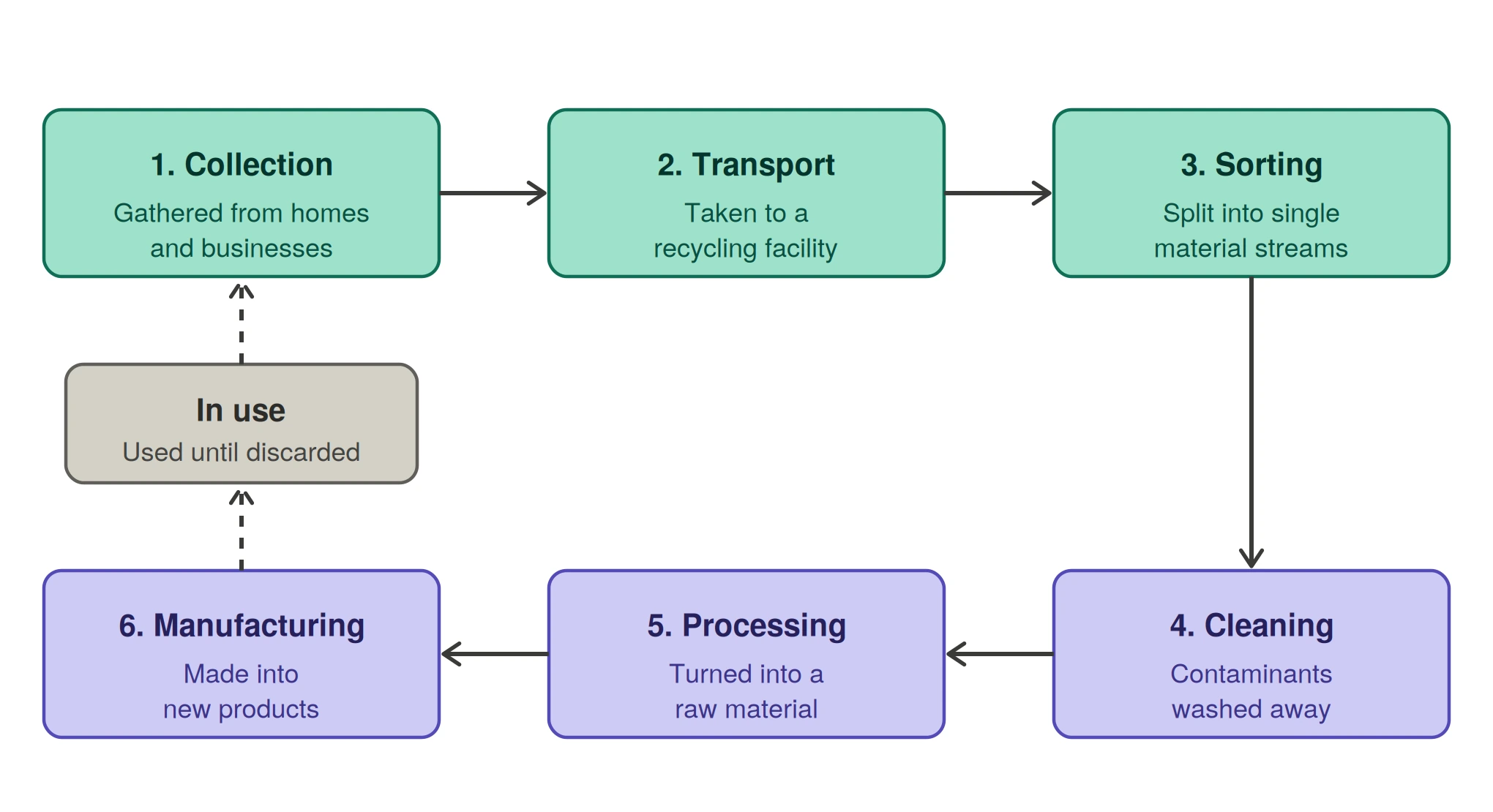
Recycling moves waste through a sequence of six general stages, each one preparing the material for the next:
1. Waste collection
Recyclable waste is collected from households through kerbside bins and local collections, and from commercial premises such as offices, shops, and restaurants, which need to arrange their own commercial waste collection due to volume and waste stream.
How that waste is collected varies by area and provider. There are three main types of collection:
- Separate collection: Materials like paper, glass, and plastic are collected separately, which tends to yield cleaner recyclables.
- Kerbside sort: Collection crews separate materials into compartments on the vehicle at the point of pickup, combining the cleanliness of separate collection with a single kerbside visit.
- Dry mixed recycling: Also called commingled or “single-stream”, recyclables go into one bin and are separated later at a facility. This is more convenient but relies more heavily on the sorting stage further down the line.
2. Transport to a recycling facility
Once collected, waste is usually taken first to a transfer station. On this local site, waste from many collection rounds is combined and consolidated into larger loads, cutting down on the number of long-distance trips.
From the transfer station, recyclables are moved to a Materials Recovery Facility (MRF), the site responsible for separating mixed recycling into clean, single-material streams.
3. Sorting recyclable materials
Modern MRFs use a combination of commercial recycling technologies to separate mixed waste quickly and accurately through processes that are interconnected via conveyor belts:
- Manual sorting: Workers manually remove contaminants that can’t be processed, such as plastic bags, nappies or other items that don’t belong in the stream.
- Magnets: Powerful overhead magnets pull out steel and other ferrous metals, such as food and drink cans.
- Eddy currents: A rapidly changing magnetic field repels non-ferrous metals like aluminium, flinging them off the line into a separate stream.
- Optical sorters: Infrared sensors scan each item, identify the material (particularly different types of plastic), and fire jets of air to divert it into the correct channel.
- Air separation: A stream of air lifts lighter materials such as paper away from heavier ones like glass, separating them by weight.
Together, these methods turn raw, mixed or single stream recycling into distinct batches of a single material, each ready for cleaning.
4. Cleaning recyclable materials
Sorted recyclables are typically transported to a processing plant, where they are first washed to remove contaminants that would compromise the finished raw material, including food residue, leftover liquids, and paper labels or adhesives.
Cleaning methods vary by material, but may include water baths, high-pressure sprays, or warm detergent or caustic washes that lift stubborn residue.
5. Processing into raw materials
With the material sorted and cleaned, it’s processed back into a usable raw form. This is the point where a used item stops being “waste” and becomes a commodity that manufacturers can buy and work with:
- Plastics are typically shredded and melted into small pellets.
- Glass is crushed into a cullet.
- Paper and card are pulped back into fibre.
- Metals are melted and cast into ingots.
Each of these can then be fed into manufacturing in place of virgin material.
6. Manufacturing new products
Finally, those raw materials are used to make new products:
- Plastic pellets become new bottles, packaging, or fibres.
- Glass cullet is melted into new jars and bottles.
- Recycled pulp becomes fresh paper and cardboard.
- Metal ingots are rolled into sheets to make cans, wire, parts, etc.
Once in use, the new product can eventually be recycled again, making this a circular economy.
How does waste processing work?
Waste processing is the broader set of activities used to manage waste after it’s collected, of which recycling is just one of four main approaches:
- Recycling: The preferred option when feasible. Materials are recovered and turned back into raw materials for new products.
- Treatment: Prepares waste for other processing routes by altering it to make it safer or easier to handle before its final destination, for example sorting, shredding, or neutralising hazardous material.
- Recovery: Heat, electricity or biogas is extracted from waste that can’t be recycled, by incineration or anaerobic digestion.
- Disposal: The last resort for waste that can’t be recycled or recovered, usually meaning landfill. Because it removes materials from use entirely and carries environmental costs, disposal sits at the bottom of the waste hierarchy.
Types of recycling currently in use
Recycling can also be classified by type, based on how a material is reprocessed into raw material and what the resulting output becomes.
Recycling by processing type
Once sorted and cleaned, waste materials can be processed back into raw materials through three methods:
- Mechanical recycling: The most common process in which materials are physically broken down without changing their chemical structure, such as shredding and melting plastic, melting glass, or pulping paper. It’s cost-effective but can slightly degrade quality with each cycle.
- Chemical recycling: Mostly used for plastics, materials are broken down to their molecular building blocks and rebuilt, handling waste that mechanical recycling can’t and producing higher-quality output, though it’s more energy-intensive and less widely available.
- Organic recycling: Biodegradable waste such as food and garden waste is broken down biologically, through commercial composting or anaerobic digestion, to produce compost, soil improver, or biogas.
Recycling by end-product
Recycling processes can also be categorised by whether the system continuously yields the same product or produces a different one:
- Closed-loop recycling: The material becomes the same type of product again, such as a glass bottle becoming a new glass bottle, keeping it in continuous use with little loss of quality.
- Open-loop recycling: The material becomes a different product, such as plastic bottles becoming clothing fibres, extending its life but usually not indefinitely.
Recycling processes for different waste materials
While the core recycling stages are broadly the same, each material is reprocessed in a slightly different way depending on its properties. Here is how the process works for the most common recyclable materials:
Paper recycling process
Type: Mechanical and closed-loop until fibres become too short.
Collected paper is sorted by grade, then mixed with water and broken down mechanically into a pulp.
The pulp is screened to remove contaminants such as staples and plastic, and often de-inked, before being cleaned, pressed, and dried into new paper.
Because the fibres shorten each time, paper can typically only be recycled around five to seven times before they become too short to reuse, and are incinerated or composted instead.
Cardboard recycling process
Type: Mechanical and closed-loop until fibres become too short.
Commercial cardboard recycling follows a similar route to paper. It’s pulped in water, then screened to remove contaminants like tape, staples, and adhesives, before the fibres are mechanically pressed and dried into a new board.
Corrugated cardboard is one of the most widely recycled materials, though, as with paper, its fibres degrade with each cycle and are eventually too short to reuse.
Plastic recycling process
Type: Mechanical and chemical; both open and closed-loop depending on end use.
The commercial plastic recycling process starts by sorting plastics by polymer type, as different plastics can’t be melted together.
Once separated, it’s typically washed, shredded into small flakes, and melted down, then formed into pellets that manufacturers use to make new products.
Some plastics that are hard to recycle mechanically, such as multi-layer film packaging and polystyrene, can instead be recycled chemically.
Processes like pyrolysis heat the plastic without oxygen to break it into an oil that can be refined into new plastic, while depolymerisation uses heat or a solvent such as methanol to reduce plastics like PET back to their basic building blocks.
Because plastic quality degrades with mechanical reprocessing, most plastics can only be recycled a limited number of times before they’re no longer usable.
Glass recycling process
Type: Mechanical and closed-loop; recyclable indefinitely without loss of quality.
A commercial glass recycling collection service transports waste to a local glass recycling facility.
It is separated by colour and cleaned of contaminants, then crushed into small pieces known as cullet.
The cullet is melted in a furnace, often alongside raw materials, and moulded into new bottles, jars, and other products.
Glass is one of the few materials that can be recycled endlessly without any loss of quality, although the process is energy intensive.
Metal recycling process
Type: Mechanical and closed-loop; recyclable indefinitely without loss of quality.
In commercial metal recycling, metals are separated by type, with magnets pulling out steel and other ferrous metals and eddy currents removing non-ferrous metals like aluminium.
The sorted metal is shredded, melted in a furnace, and cast into ingots or sheets ready for manufacturing.
Like glass, metal can be recycled repeatedly with no loss of quality, which is why recycling aluminium uses a fraction of the energy needed to produce it from raw ore.
What are the biggest issues in the recycling industry?
Recycling in the UK faces several persistent challenges that limit how much waste is actually recovered and reused. The biggest issues stem from a mix of consumer behaviour, economics, and infrastructure, and include:
- Contamination: Non-recyclable items and residue mixed into recycling remain one of the largest problems, lowering the quality of recovered materials and, in the worst cases, sending entire loads to landfill or incineration.
- Inconsistent collection systems: Recycling rules vary widely between councils, with different areas accepting different materials. This confuses residents, drives contamination, and makes nationwide consistency difficult.
- Volatile commodity prices: Recycled materials are sold as commodities, so when the market price for recycled plastic, paper, or metal falls, recycling can become less economically viable than producing new material.
- Reliance on waste exports: The UK has historically exported a significant share of its recycling abroad. Tighter import restrictions in destination countries have reduced this option, exposing a shortage of domestic reprocessing capacity.
- Hard-to-recycle materials: Many everyday items, such as multi-layer packaging, black plastics, and mixed-material products, are difficult or uneconomic to recycle with current infrastructure, so they’re often discarded.
Waste recycling process FAQs
Our business waste management experts answer commonly asked questions regarding the waste recycling process:
Why does contamination affect the recycling process?
Sorting and processing depend on clean, single-material streams, so contamination throws the process off.
It can jam or damage equipment, lower the quality of the recovered material, and in the worst cases cause an entire batch to be rejected and sent to landfill or incineration instead of being recycled.
How long does the recycling process take from collection to a new product?
It varies by material, but the whole cycle usually takes a few weeks to a few months. Some materials like aluminium drink cans move especially fast, and can be collected, recycled, and back on the shelf as a new can in as little as six weeks.
Why are some recyclable materials rejected after arriving at a recycling facility?
Materials are most often rejected because of contamination, but a load can also be turned away if it contains the wrong types of material, is too mixed to separate economically, or if there’s no viable market for the recovered material at the time.
Rejected loads are usually sent to incineration or landfill.
Can recyclable waste be sorted again if it is contaminated?
Sometimes. Lightly contaminated material can be re-sorted to remove the problem items, but this adds cost and isn’t always worthwhile.
Heavily contaminated loads, such as waste soaked in hard to remove food or liquid, are often simply discarded.
Does recycling always happen within the UK?
No. The UK has historically exported some of its recycling abroad for reprocessing. Tighter import restrictions in destination countries have reduced this in recent years, increasing the pressure to expand the UK’s own reprocessing capacity.
Why are some products made from recycled materials not recyclable again?
Recycling can degrade a material’s quality, so some recycled products reach the end of their usable life.
This is common with open-loop recycling, where a material is turned into a different product, such as plastic bottles made into clothing fibres, which often can’t be recycled again and are eventually discarded.
What happens if recyclable waste arrives at the wrong processing facility?
It’s either redirected to the correct facility or rejected, depending on what it is and how practical it is to move. Any delay or transfer adds cost, and if the material can’t be handled or rerouted, it may end up being sent for disposal.
How do recycling plants measure contamination rates in incoming waste?
Facilities typically measure contamination by sampling incoming loads and inspecting them, either visually or by manually sorting a portion to see how much doesn’t belong.
These checks help facilities monitor quality, price loads, and give feedback to the councils or businesses supplying the waste.
 Back to blog
- Share: