 Our use of cookies
The waste hierarchy pyramid: A guide for businesses
The waste hierarchy pyramid is a five-step framework set out in UK law that ranks waste management methods in order of environmental preference.
Prevention sits at the top as the most preferable option, followed by preparing for reuse, recycling, other recovery, and disposal as the last resort.
UK businesses are legally required to apply the waste hierarchy when managing commercial waste, making it a core principle of commercial waste regulations and a useful framework for reducing the environmental impact of commercial waste.
The waste hierarchy pyramid
The waste hierarchy is shown as an inverted pyramid, with the most environmentally preferable option at the top and the least preferable at the bottom. The wider the tier, the higher the priority for businesses managing commercial waste.
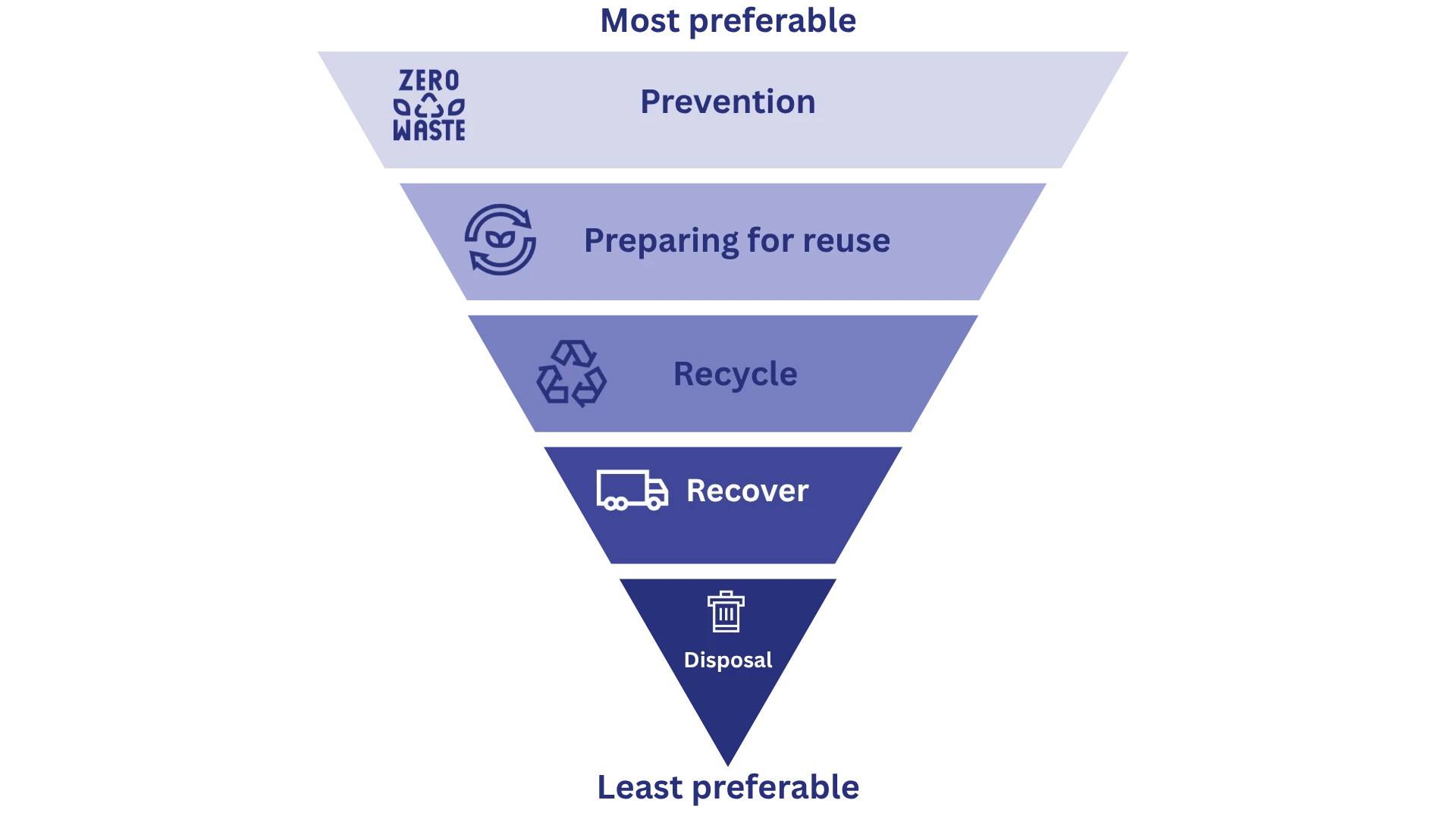
Prevention
Definition: Avoid waste creation at source.
Prevention sits at the top of the waste hierarchy because the most environmentally preferable waste is the waste that is never created. Businesses can prevent waste by redesigning products to use fewer materials, switching to digital alternatives, ordering stock more accurately to reduce surplus, and cancelling unused subscriptions or deliveries.
For practical examples and strategies, see our guide on waste minimisation.
Preparing for reuse
Definition: Find a secondary use for waste.
Preparing for reuse covers any process that gives a product or material a second life rather than treating it as waste. This includes cleaning, repairing, refurbishing, or repurposing items, as well as redistributing unwanted goods through resale or charity donation.
This step is particularly relevant for commercial electronic waste, office furniture, and textiles, where functional items are often discarded long before the end of their useful life.
Recycling
Definition: Process materials into new products, substances, or materials.
Recycling involves processing waste materials so they can be used again, either for the same purpose or a different one. It covers the most common waste streams produced by UK businesses and is supported by widely available collection services, including:
- Commercial dry mixed recycling
- Commercial glass recycling
- Commercial cardboard recycling
- Commercial food waste collection
Effective recycling depends on good waste segregation at source, which keeps materials clean and increases the proportion that can be processed.
Recover
Definition: Extract energy or materials from waste that cannot be reused or recycled.
Recovery covers waste treatment processes that capture value from waste before disposal. The two most common forms are:
- Anaerobic digestion or composting of organic and food waste, which produces biogas and soil-improving digestate.
- Incineration of residual waste at an energy from waste facility, which generates electricity and heat for the grid.
Recovery sits below recycling in the hierarchy because the materials themselves are not preserved, but it diverts significant volumes of waste from landfill.
Disposal
Definition: The final option when no viable alternatives exist.
Disposal is the least preferable step in the waste hierarchy and refers to sending residual waste to a landfill site for permanent burial. It is reserved for waste that cannot be prevented, reused, recycled, or recovered.
The UK government actively discourages disposal through the landfill tax, which makes sending waste to landfill significantly more expensive than recycling or recovery alternatives.
The legal requirements of the waste hierarchy
The waste hierarchy is not just guidance; it is a legal duty for every UK business that produces, handles, or manages waste. It was incorporated into UK law through the Waste (England and Wales) Regulations 2011, which transposed the EU Waste Framework Directive, and remains in force despite the UK’s exit from the European Union.
Failure to apply the waste hierarchy correctly can result in enforcement action from the Environment Agency, including fines, formal warnings, and prosecution in serious cases. The following sections explain what the legal duty involves in practice.
Mandatory application
Under regulation 12 of the Waste (England and Wales) Regulations 2011, any business that imports, produces, collects, transports, recovers, or disposes of waste is legally required to apply the waste hierarchy when transferring that waste. This applies to producers of any volume, from small offices to large industrial sites, and covers all waste types, including general, recycling, hazardous, and clinical waste streams.
The duty is to take all reasonable measures to apply the steps in the order set out in the hierarchy, prioritising prevention, then preparing for reuse, then recycling, then recovery, with disposal as the final option.
Reasonable steps
The legal standard is that businesses must take reasonable steps to apply the hierarchy, rather than meet an absolute requirement. Reasonable steps will vary depending on the size of the business, the type of waste produced, and what alternatives are practically available locally.
Examples of reasonable steps include conducting a waste audit to identify opportunities for prevention and recycling, segregating waste at source, and choosing licensed waste carriers that offer recovery options rather than direct landfill disposal.
Declaration and documentation
Every time a business transfers waste to another party, the transfer must be accompanied by a waste transfer note or, for hazardous waste, a consignment note. These documents must include a declaration confirming that the waste hierarchy has been applied.
The declaration must be signed by both the waste producer and the receiving carrier or operator. Records must be kept for at least two years for non-hazardous waste, and at least three years for hazardous waste. Failure to complete or retain these documents is a separate offence under the regulations.
Justification
If a business chooses a step lower down the hierarchy than the most preferable option, it must be able to justify that decision. Acceptable justifications are limited to grounds set out in the regulations, including technical feasibility, economic viability, and overall environmental impact.
For example, a business may justify sending a particular waste stream for recovery rather than recycling if no recycling facility for that material exists within a reasonable transport distance, since the carbon cost of long-distance transport could outweigh the recycling benefit. Justifications should be documented and available for inspection by the Environment Agency.
Duty of care
The waste hierarchy operates alongside the wider duty of care under section 34 of the Environmental Protection Act 1990. The duty of care requires every business to ensure that waste is stored safely, transferred only to authorised parties, and accompanied by accurate documentation throughout its journey to final treatment or disposal.
Applying the waste hierarchy is one of the core obligations within the duty of care. Businesses that meet the duty of care will, by extension, be meeting the legal requirements of the waste hierarchy. The government has published detailed guidance on applying the waste hierarchy for businesses and public bodies that generate waste.
Waste hierarchy alternatives
The steps of the waste hierarchy explained above are those set out in UK law.
However, there are now two notable variants of the waste hierarchy that are commonly used. We’ll explain these in this section.
The 3 R’s
The 3 R’s is a simplified version of the waste hierarchy, commonly used as an educational tool for adults and children to promote awareness of waste management:
- Reduce: Minimise the amount of waste generated.
- Reuse: Extend the life of items by finding new uses for them.
- Recycle: Process waste materials into new products.
The ‘zero waste’ hierarchy
The zero waste hierarchy extends the traditional waste hierarchy by prioritising waste prevention and management strategies to achieve “zero waste.” This concept aligns with a fully circular economy, where minimal raw inputs are needed because resources are used perpetually, eliminating waste disposal.
The zero waste hierarchy introduces the following steps (known as the “7Rs”):
- Refuse: Avoid using or purchasing unnecessary products and packaging.
- Reduce: Minimise waste by choosing durable, long-lasting products.
- Re-use: Extend the life of products by reusing them or repurposing materials.
- Repair: Fix items instead of discarding them.
- Recycle: Process materials to create new products.
- Rot: Compost organic waste to return nutrients to the soil.
- Rethink: Innovate and design products and systems that eliminate waste.
The future of the waste hierarchy
Since the waste hierarchy was implemented into UK law in 2011, there have been significant improvements in waste management practices, leading to reduced waste generation and enhanced recycling rates.
Between 2010 and 2020, the recycling rate for commercial and industrial waste increased from 52% to nearly 70%, while the amount of waste sent to landfill decreased by approximately 65% due to the prioritisation of other waste management methods over disposal.
These successes are largely due to the waste hierarchy’s focus on promoting a more sustainable and efficient use of resources by prioritising prevention, reuse, and recycling.
Government forecasts suggest that with continued adherence to the waste hierarchy, recycling rates for commercial waste could exceed 80% by 2035.
 Back to blog
- Share: